
•

Financial history tends to remember technological revolutions. It should remember criminal ones. That distinction matters here: the criminals shaping this next transformation are already moving faster than the institutions meant to stop them, and treating that as background noise instead of the story is how banks end up caught flat-footed.
Stablecoins settled roughly $33 trillion in transaction volume in 2025, according to Bloomberg Intelligence reporting through Artemis Analytics, nearly double the $17 trillion Visa processed globally over the same period, per Visa's own annual report.
That comparison should end a decade-long debate, though not for the reason most people think. The debate has always been framed as a contest, decentralized future versus regulated past, will digital assets replace banks? Wrong question. The real one is what the next generation of financial institutions will look like, and the answer is neither traditional banking nor today's digital asset platforms. It's the convergence of both.
We've seen what that convergence looks like from inside markets where digital assets are daily financial infrastructure, not a talking point. Across sub-Saharan Africa, Asia-Pacific, and Latin America, compliance discipline in emerging markets is already outpacing the regulatory frameworks of developed ones. This isn't just a technology shift. It's a fundamental rewiring of how value moves, and the catalyst forcing that rewiring isn't innovation. It's financial crime.
The Three Horizons of Financial Crime
To understand why convergence is inevitable, we must first honestly examine why current models are failing. We are witnessing a transition across three horizons of financial crime:
Horizon 1: Sequential Crime (The Past)
Criminals committed fraud, then laundered money, then evaded sanctions. Controls could be siloed because the crime was siloed. Fraud, AML, and Sanctions teams operated independently.
Horizon 2: Networked Crime (The Present)
A sophisticated criminal network today uses AI-generated synthetic identities to commit fraud, moves value instantly through Stablecoins, interacts with sanctioned entities, and cashes out across jurisdictions. The crime happens simultaneously across risk domains.
Horizon 3: Automated Crime (The Future)
AI-driven crime executing at machine speed across multiple blockchains and jurisdictions simultaneously.
In our experience, too many financial institutions are still using Horizon 1 compliance architectures to fight Horizon 2 crime, while criminals are already moving toward Horizon
According to industry estimates from Equifax and LexisNexis, synthetic identity fraud alone is now estimated to cost financial institutions between $20 billion and $40 billion globally each year. Deep Instinct research from July 2025 found that 45 percent of financial services organizations faced an AI-powered cyberattack in the last 12 months.
You cannot fiercely protect your clients from a Horizon 3 threat with a Horizon 1 organizational chart.
The Trust-Speed Matrix
This evolution in crime exposes the core tension in modern finance. We view this through what we call the Trust-Speed Matrix.
Financial institutions today are trapped in one of two quadrants:
Legacy Operators (High Governance, Low Speed): Traditional banks. Safe, trusted, but increasingly uncompetitive for the global movement of value.
Fragile Innovators (Low Governance, High Speed): Early cryptocurrency platforms. Fast, but unable to secure institutional capital or regulatory approval.
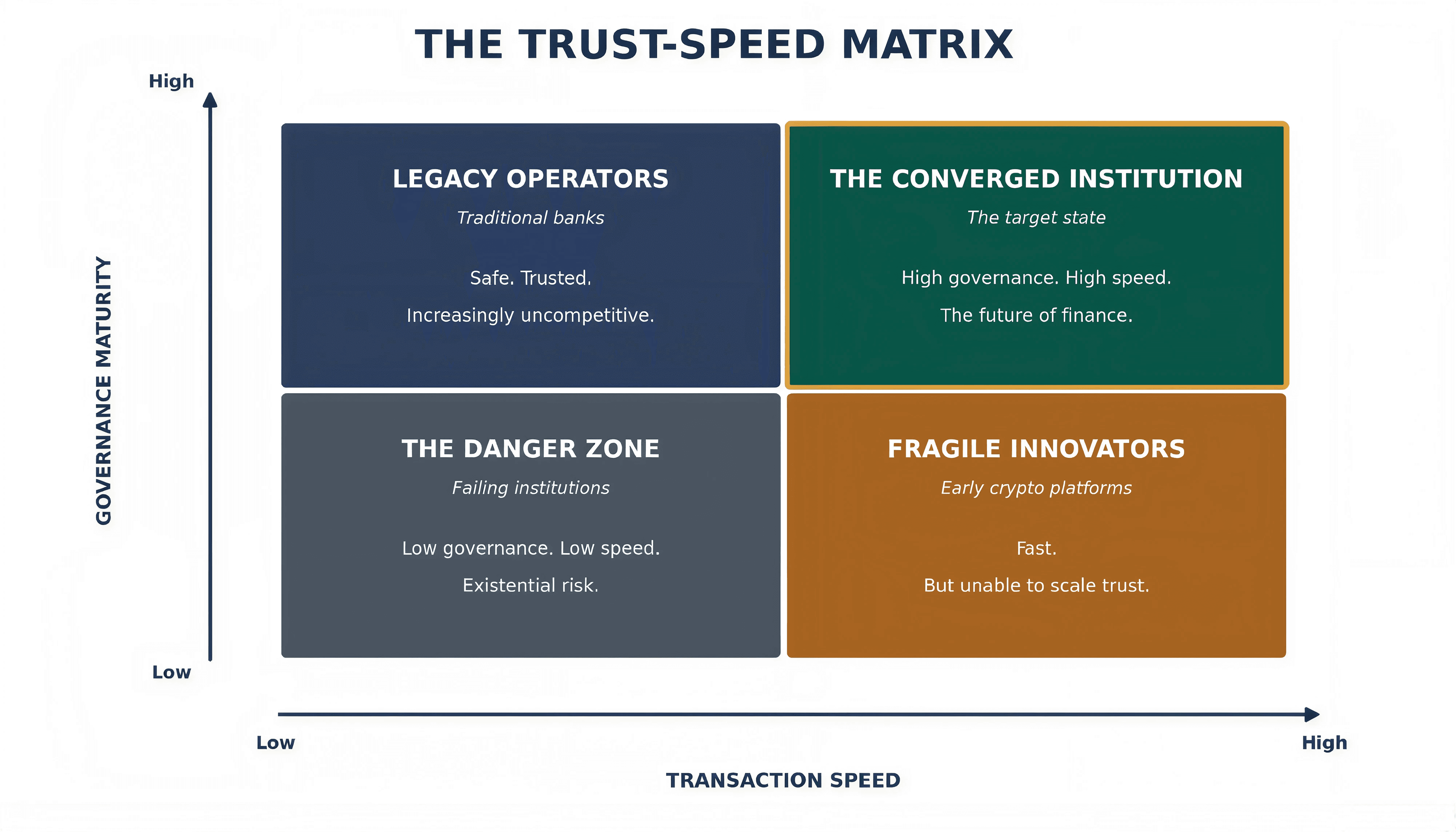
Most digital asset firms believe they are moving toward a third, converged quadrant. In reality, regulatory pressure is often forcing them to simply slow down, pushing them toward the Legacy quadrant.
True convergence requires building speed into governance, not sacrificing one for the other. The financial future belongs to the institution that can boldly hold both simultaneously.
The Evidence of Convergence
Across every major financial center, the signs of this convergence are clear.
According to Qivalis, a consortium of 37 leading European banks has launched to develop a regulated, euro-denominated Stablecoin. The European Central Bank reported in March 2026 that European issuers have placed close to €4 billion in fixed-income instruments based on distributed ledger technology since 2021.
In the Americas, according to Wall Street Journal reporting from June 2026, JPMorgan, Citigroup, and other major U.S. banks are planning to launch a tokenized deposit network in the first half of 2027. JPMorgan has already moved its JPM Coin onto Coinbase's Base blockchain, a public Ethereum layer-2 network, according to the bank's official announcement in November 2025.
In emerging markets, the adoption is staggering. According to Chainalysis's 2025 Geography of Cryptocurrency Report, sub-Saharan Africa received over $205 billion in on-chain value in the year ending June 2025. Latin America moved $1.5 trillion on-chain in recent years. Mexico alone received a record $64.7 billion in remittances in 2024, with Stablecoin-based transfers capturing a fast-growing share of that corridor, according to Rain.xyz research.
These developments are not happening in isolation. Institutional participation demands steadfast institutional standards.
The Converged Risk Model
After leading transaction risk programs across both emerging and developed financial ecosystems, I have become convinced that the future belongs to what we call the Converged Risk Model.
Rather than treating fraud, AML, sanctions, blockchain intelligence, and cyber risk as independent control environments, the Converged Risk Model views them as interconnected signals contributing to a single, highly secure assessment of transaction risk.
In this model, every transaction becomes more than a payment. It becomes a continuously evolving risk event. Identity intelligence informs transaction monitoring. Blockchain analytics strengthen sanctions screening. Cybersecurity telemetry enhances fraud detection.
Within five years, institutions that still treat financial crime as a compliance function rather than a strategic, protective capability will struggle to compete for institutional capital.
The "Decision Density" Metric
Historically, transaction monitoring focused on identifying unusual activity. Success was measured by the number of alerts generated.
As financial systems become increasingly real-time, that philosophy fails. Generating alerts is no longer enough. The real challenge is making accurate decisions to empower clients before financial harm occurs.
We must move away from "alerts generated" to a new metric: Decision Density.
Decision Density measures integration. It asks: how much contextual intelligence informed a decision before settlement?
We can think of it as a conceptual equation:
Decision Density = Integrated Intelligence ÷ Decision Time
What contributes to that integrated intelligence? Identity intelligence, blockchain intelligence, device intelligence, sanctions intelligence, behavioral intelligence, network intelligence, and historical customer context.
Within five years, institutions that still measure compliance effectiveness by the number of alerts their analysts clear will be unbankable. The only metric that will matter is Decision Density: the volume of cross-domain intelligence you can boldly apply to a transaction before it settles.
The Regulatory Imperative
This convergence is not just an institutional imperative; it is a regulatory one. Regulators should welcome the Converged Risk Model because it finally aligns supervision with how financial crime actually operates.
When institutions view risk through isolated silos, they produce fragmented reporting that forces regulators to piece together the broader criminal narrative. A converged model provides regulators with honest, holistic intelligence, moving supervision from reactive enforcement to proactive systemic protection. It bridges the gap between the speed of innovation and the mandate of financial integrity.
The Choice Ahead
We began with the wrong question: will digital assets replace banks?
The real story is convergence. Traditional finance still has the deeper lesson to teach on governance, and digital assets still have the deeper lesson to teach on transparency and speed. Neither side gets to skip its homework.
A bank that adopts blockchain settlement without rebuilding its risk architecture for real-time decisioning has not modernized—it has simply moved its blind spots faster. A digital asset platform that scales globally without the governance discipline banks spent decades building has not innovated—it has borrowed time it will eventually have to repay.
Trust is no longer something an institution claims. It is something an institution has to prove, continuously, at the speed of the transactions it processes.
History rarely rewards institutions that defend yesterday's models against tomorrow's realities. It rewards those that recognize when two competing ideas have quietly become one, and move first to securely build the operating model that makes both true at once.
Banking taught us how to build trust. Digital assets taught us how to move value. Financial crime is teaching us that our optimistic financial future requires both.
That moment has arrived for finance. The question is not whether convergence will happen. It is whether your institution will lead it or follow it.